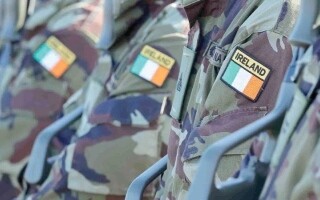
The British government attempted to draw Ireland into the war, but was prepared to help it defend itself. Nevertheless, Ireland's position led to accusations of 'free-riding' on NATO, especially the UK, regarding air and sea security. Dublin is incapable of defending its airspace or exclusive economic zone. Despite being responsible for 16% of the EU's territorial waters and 75% of transatlantic cables passing through its waters, Ireland is 'completely unable to defend itself,' according to European analysts. Even as NATO members increase defense spending to 2-5% of GDP, Dublin spends only 0.2% of its GDP on security and defense—the lowest rate in Europe. This has led to complaints from many European countries that Ireland 'free-rides' on NATO's protection without contributing to the continent's defense against common threats. Analysts believe that 'Ireland has effectively abdicated its responsibility for protecting Europe's northwestern borders.' Despite this, Ireland shows no signs of joining NATO, as historically neutral countries like Finland and Sweden have, but it may seek closer ties with the alliance to ensure its maritime security. There are calls for the Irish Defence Forces to participate in joint exercises with NATO members, including the UK and France. Although it is unlikely that Ireland will join the alliance anytime soon, Dublin has finally announced it will purchase hundreds of French-made armored vehicles and new artillery systems, which theoretically gives it some ability to defend itself. This equipment will help transform the Irish Armed Forces from a current light infantry force into one similar to NATO's mechanized units. Under the agreement between Dublin and Paris, the modern French-made vehicles will enter service by the end of the current decade, replacing outdated light armored systems from the UK and Switzerland that remained in service long past their due date. Ireland is also a member of the Euro-Atlantic Partnership Council and cooperates with NATO under the 'Individual Partnership Programme'. This cooperation covers various areas, including peace support operations. A key focus of this partnership is working together to develop military capabilities and improve the interoperability of the Irish Armed Forces with those of allies and partners in NATO, EU, and UN missions. However, given its land border with Northern Ireland, a UK province, and its strategic location in the North Atlantic, Ireland would likely receive NATO protection in the event of a war. This is a reminder that the UK would certainly have assisted Ireland during World War II had Germany invaded the country. Close cooperation with the EU and NATO is an extremely sensitive issue in Ireland. Prime Minister Michael Martin told members of the Irish parliament earlier this year: 'If anything happens to gas supplies from Britain, our economy will collapse within 10 days.' Ireland's future partnership with NATO could include increasing the number of radars and other sensors to detect air and sea threats, as well as cooperating with the EU on data exchange. Thus, Ireland is completely unable to defend itself despite being responsible for 16% of the EU's territorial waters. However, Dublin simply has no other choice.